
The assumption that mobile marketing tours require $300,000 or more stops good programs from ever starting. It is wrong.
Programs in the $50,000 to $150,000 range achieve 70 to 80% of the engagement metrics that premium six-figure-plus programs deliver1. The gap between a $75K rental program and a $350K custom build is real, but smaller than most marketers expect, and for many brand objectives it does not matter. Here is how to build a mobile tour that performs without the premium price tag.
The 70 to 80% Rule
The relationship between experiential budget and performance is logarithmic, not linear. The first $50K buys the biggest jump in engagement. Each additional dollar delivers diminishing returns.
A custom semi-trailer with architectural millwork, integrated AV, and climate control is a superior environment. No question. But a well-designed rental vehicle with smart graphic wraps, thoughtful product display, and trained staff delivers the metrics that actually matter: dwell time, lead capture, and brand recall.
The 20 to 30% performance gap between budget and premium programs shows up primarily in three areas: social sharing rate (bespoke environments photograph better), multi-sensory engagement (custom spaces integrate more senses), and scalability (custom assets are built for 50+ activations). If those are not your primary KPIs, the budget tier gets you where you need to go.
Three Mobile Tour Program Tiers Compared
Guerilla Cube: $40K
The guerilla cube is a compact, portable activation unit, typically 8×8 or 10×10 feet, that deploys from a cargo van or small truck. Total program cost for a 5 to 8 market activation runs approximately $40,0002, including fabrication, graphics, logistics, and basic staffing.
What you get: a focused, single-message activation that works in high-traffic pedestrian areas, retail parking lots, and event perimeters. The format forces simplicity, which is often an advantage. One product. One demo. One conversion action.
What you give up: interior space, climate control, and the “destination” feeling that larger formats create. Dwell time typically runs 3 to 5 minutes versus 8 to 12 for larger formats.
Rental 10-Market Program: $75K
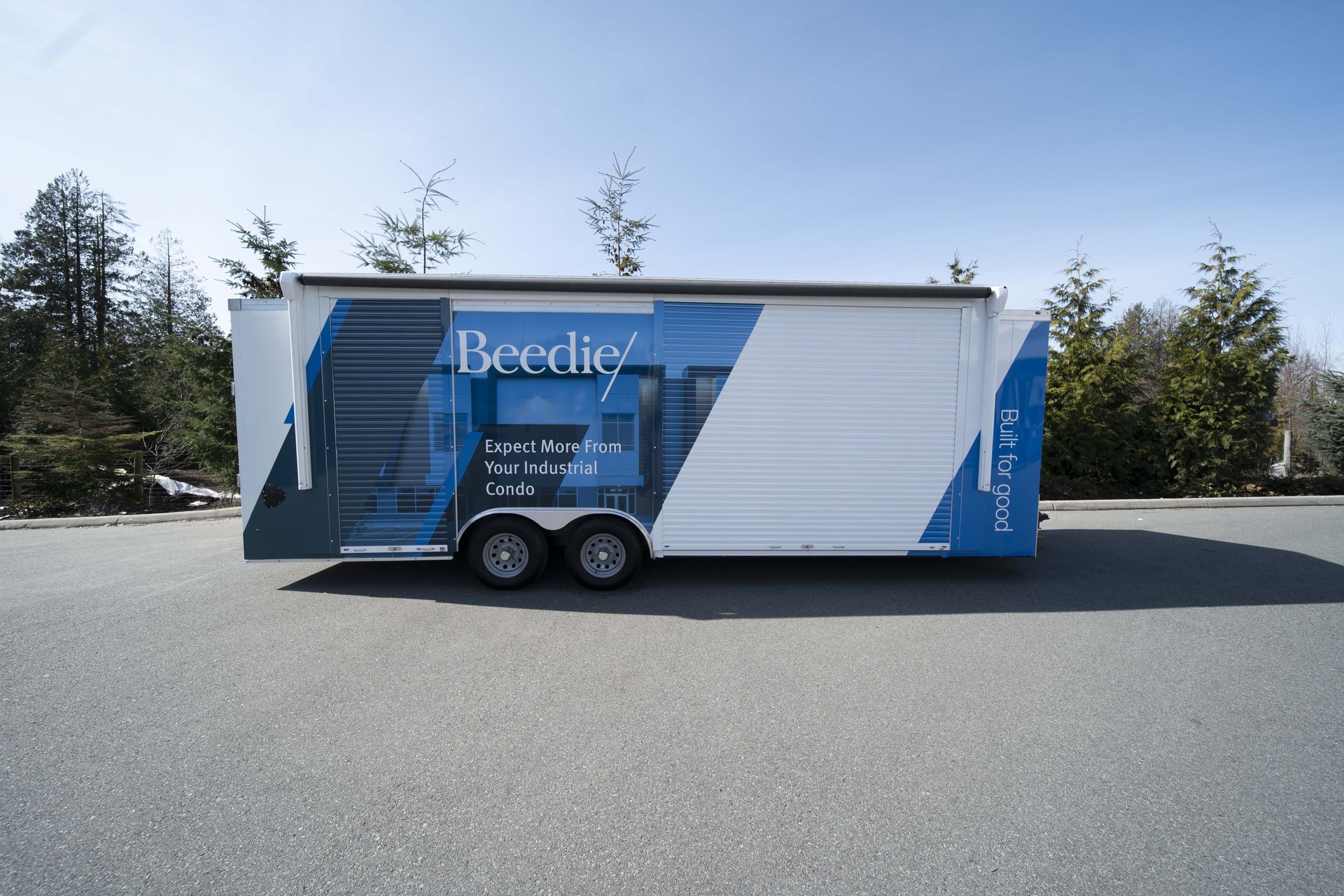
This is the sweet spot for brands entering the mobile tour category. Rent a professionally built vehicle (typically a 20 to 26-foot trailer or converted box truck), apply custom brand wraps and interior graphics, and run a 10-market tour over 4 to 6 weeks.
Total program cost of approximately $75,000 covers vehicle rental, graphic production, route logistics, staffing, permits, and basic technology integration. The vehicle arrives with structural elements (counters, shelving, lighting, power) already built. You customize the skin and the experience, not the shell.
What you get: a professional, enclosed environment with 100 to 200 square feet of activation space. Enough room for product display, demonstration, and lead capture. Climate-controlled in most rental units. Dwell time comparable to custom programs at 7 to 10 minutes.
What you give up: uniqueness. Rental vehicles have standardized footprints. Your brand wrap differentiates the exterior, but the interior layout has constraints and you cannot modify the structural envelope.
Custom Semi-Trailer: $350K+
The premium tier. A purpose-built semi-trailer with 400 to 1,000+ square feet of activation space, custom architecture, integrated technology, and a design that serves as a brand statement before anyone steps inside.
This is the format used by brands running 20+ market national tours. The asset is designed for 3 to 5 years of deployment and amortized across dozens or hundreds of activations. For brands running fewer than 15 to 20 activations per year, this tier rarely pencils out. The math points to rental.
Rental vs. Custom: The Break-Even Math
The decision between rental and custom is a utilization calculation, not a quality judgment.
Rental programs break even at 3 to 4 activations per year3. Below that, you are paying for vehicle availability you are not using. Above that, rental costs start approaching the annual amortization of a custom build.
Custom programs break even at 15 to 20+ activations per year3. A $350,000 custom trailer amortized over 5 years costs $70,000 per year. At 20 activations, that is $3,500 per activation for the vehicle alone, competitive with rental rates. At 10 activations, it is $7,000 per activation, well above rental pricing.
If your first-year plan calls for 6 to 12 activations, rent. Use the first year to validate the format, refine the experience, and build the internal business case for a custom asset. Most of the brands we now build custom programs for started on rentals.
Technology Tiers That Match Your Budget
Essential (Under $2K)
- Tablet-based lead capture (Typeform, HubSpot mobile, or a custom form)
- QR codes linking to product pages or landing pages
- Bluetooth speaker for ambient audio
- Basic lighting (LED strip, portable spots)
This tier handles lead capture and basic atmosphere. It lacks tracking automation but covers the fundamentals. For a 5 to 8 market guerilla program, this is sufficient. Every dollar above this threshold should go to staff and product first.
Moderate ($5K to $15K)
- iPad kiosk stations with guided product experiences
- NFC tap for instant content delivery
- Wi-Fi hotspot with captive portal for data capture
- Professional lighting rig (programmable LED, key lights)
- Portable monitor or TV for video content
This tier adds passive data capture and richer product storytelling. The NFC tap alone can double your data capture rate by removing friction from the exchange. For rental programs, this is the right investment level.
Full Integration ($25K+)
- RFID or sensor-based visitor tracking (dwell time, flow, zone engagement)
- Interactive touchscreens with product configurators
- Integrated CRM sync (real-time lead routing to sales)
- Professional AV system (surround sound, projection mapping, large-format displays)
- Environmental controls (scent, haptic, temperature)
This tier is purpose-built for custom vehicles running 15+ activations. The sensor infrastructure pays for itself in optimization data, but only if you have enough activations to iterate on.
Where Budget Programs Win
Budget programs have structural advantages that premium programs do not.
Speed to market. A rental program can be live in 4 to 6 weeks. A custom build takes 12 to 20 weeks. If your product launch is in 8 weeks, the rental is not a compromise. It is the only option.
Route flexibility. Rental vehicles are available in most major markets. You can run a West Coast tour one month and a Prairies tour the next without repositioning a custom asset cross-country.
Lower risk. If your first mobile tour underperforms, you have lost $75K, not $350K. The learning is the same either way.
Where to Cut and Where to Protect
Cut vehicle customization. A professional wrap on a clean rental vehicle looks sharp. Nobody inside the experience is thinking about whether the walls are custom millwork or standard panels.
Cut technology beyond your measurement needs. If you are not going to analyze sensor data, do not install sensors.
Protect staffing. The quality of the human interaction is the single largest driver of dwell time and conversion, regardless of budget tier. Undertrained staff in a $350K trailer will underperform well-trained staff in a $40K cube. Every time.
Protect the core experience. Whatever your product demo or engagement moment is, fund it fully. A tight, well-rehearsed 8-minute experience in a modest space beats a scattered 3-minute wander through an expensive one.
The budget is a constraint. It does not have to be a limitation.
Sources
- Sequoia budget-tier engagement benchmark, The Complete Guide to Mobile Marketing Tours, 2026. Industry context: Statista Event Industry data.
- Sequoia vehicle-tier program cost data, single-vehicle strategies section, The Complete Guide to Mobile Marketing Tours, 2026.
- Rental vs. custom break-even framework, The Complete Guide to Mobile Marketing Tours, 2026.
Want the full vehicle comparison, tech stack detail, and case studies behind these numbers? Download The Complete Guide to Mobile Marketing Tours for 62 pages of frameworks, benchmarks, and worked examples from brands like the Vancouver Canucks and Travis Mathew.